Stendhal by Francesco Manzini
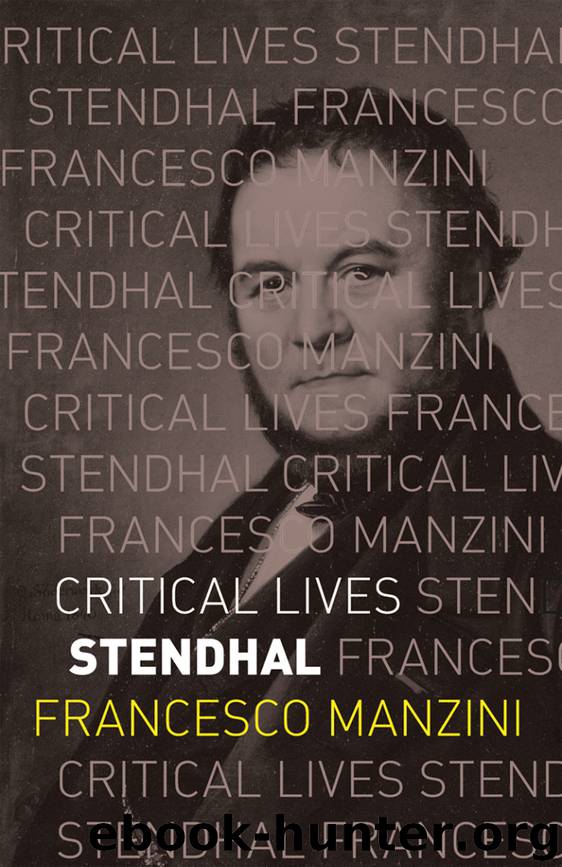
Author:Francesco Manzini
Language: eng
Format: epub
Publisher: Reaktion Books
5
Métilde: De l’Amour, 1815–21
In the Vie de Henry Brulard, Henry makes what he himself acknowledges might appear to be a surprising statement about his attitude to the fall of Napoleon: ‘I fell in April 1814, at the same time as Nap[oleon]. I came to Italy in order to live as I had done in the Rue d’Angivillers [. . .] Who would believe it, but, as for me personally, this fall gave me pleasure’ (OI, II, p. 540).
Stendhal had had enough of empire. It was time to start again, to return in spirit to the apartment where he had spent all of 1803 studying with a view to becoming a writer, and to return in body to Milan, his elective hometown. It is there that Stendhal would come the closest to falling in love and consequently learn to become a writer, although when he first arrived, he thought he was already in love and already a writer.
Stendhal had been working on and off on a variety of literary and (art) historical projects as he stumbled his way along the various connecting carriages of the imperial gravy train from 1807 to 1814. He produced nothing of any great interest in this period, but, then again, his heart wasn’t really in it. On 1 September 1810, he used his last will and testament to stipulate the founding of an annual literary prize to run in perpetuity, spreading his glory in rotation to London, Paris, Berlin or Göttingen (for how to choose between them?), Naples and Philadelphia (OI, II, pp. 989–91): he was imagining the outsourcing of his literary career, no longer having the time to bother with such trifles himself, not now that he had prospects and fine clothes. Somebody else could do the writing and earn him the posthumous literary glory he craved. It is in this period of his life that he tried to become – and in the meantime to pass himself off as – a member of the new imperial aristocracy. In particular, he hoped to touch his father for enough money to buy himself the title of baron, and started signing himself Henri de Beyle. Brulard notes of this phase in his life, ‘in reality, I’ve never been ambitious, but I thought I was in 1811’ (OI, II, p. 542). Like so many of his generation, and ours, he had been seduced by wealth, status and the illusion of power. Put another way, he had become ensnared by the pleasures of social competition, or what Rousseau terms amour-propre, and so was gravely at risk of becoming the kind of stuffed shirt he had spent most of his life abhorring.
Stendhal appears to have recognized the possibility, and even the likelihood, that, as moderns, we are all, always and everywhere, engaged in social competition, often for pathetically low stakes; it would follow that we can only ever serve as rivals to each other, even when we find ourselves face-to-face with the people to whom we feel closest. It is
Download
This site does not store any files on its server. We only index and link to content provided by other sites. Please contact the content providers to delete copyright contents if any and email us, we'll remove relevant links or contents immediately.
Waking Up in Heaven: A True Story of Brokenness, Heaven, and Life Again by McVea Crystal & Tresniowski Alex(37924)
Still Foolin’ ’Em by Billy Crystal(36462)
Cecilia; Or, Memoirs of an Heiress — Volume 1 by Fanny Burney(32715)
Cecilia; Or, Memoirs of an Heiress — Volume 2 by Fanny Burney(32082)
Cecilia; Or, Memoirs of an Heiress — Volume 3 by Fanny Burney(32062)
Fanny Burney by Claire Harman(26717)
Empire of the Sikhs by Patwant Singh(23199)
We're Going to Need More Wine by Gabrielle Union(19166)
Hans Sturm: A Soldier's Odyssey on the Eastern Front by Gordon Williamson(18714)
Plagued by Fire by Paul Hendrickson(17533)
Out of India by Michael Foss(17020)
All the Missing Girls by Megan Miranda(16677)
Cat's cradle by Kurt Vonnegut(15549)
For the Love of Europe by Rick Steves(14885)
Pimp by Iceberg Slim(14781)
Molly's Game by Molly Bloom(14254)
Bombshells: Glamour Girls of a Lifetime by Sullivan Steve(14214)
Leonardo da Vinci by Walter Isaacson(13483)
4 3 2 1: A Novel by Paul Auster(12608)
